01
Trace
Build your private data map.
Add services and accounts you recognize. Review every suggested relationship before it becomes part of your map.
open-record.org helps you map likely data holders, review a scoped rights request, and organize what comes back—without turning your legal power into hidden automation.
Review comes first. Requests are not sent without your approval and operator review during the private beta.

Built for people—not privacy departments.
Start with what you know. Build confidence before taking action. Keep the result useful after the legal request is over.
Trace
Add services and accounts you recognize. Review every suggested relationship before it becomes part of your map.
Mandate
See the organization, route, scope, and exact request. Decide whether to approve it or leave it alone.
Reveal
Keep the evidence, returned files, deadlines, and next steps together in a private, reviewable workspace.
The beta is designed around a deliberate first success—not a wall of accounts or a burst of legal emails.
Start with a service, account email, or domain. Inbox access is not required to begin.
See why an organization appears and decide whether it really belongs in your data map.
See the holder, route, wording, and scope. Nothing is sent until you have reviewed and approved the exact action.
Track replies, proof requests, portal steps, deadlines, and returned records without losing the evidence trail.
Example interface. Approval is scoped to one holder and one request.
Every screen should make four things clear: what is happening, why it matters, what is uncertain, and what you can safely do next.
A suggestion is not treated as truth. You decide which relationships are real and worth acting on.
You can open the case text and delivery details before choosing. A single confirmation surface is still being refined during the beta.
The current beta uses a manual identity check before supported sends. Identity documents are kept out of request emails by default while route-specific proof is developed.
Requests, replies, delivery events, files, and decisions remain connected to one understandable case history.
open-record.org is built to coordinate your rights—not to create another invisible profile about you.
Read the privacy noticePersonal-data rights are real, but the routes are messy. The product should remove effort without hiding that reality.
Some reply by email. Others require an account portal, a direct confirmation, or delivery to you instead of open-record.org.
An organization may still ask to verify you or open-record.org before it releases sensitive information.
The first job is to preserve what arrived, organize it safely, and show what is missing or uncertain.
No bulk-send incentives. No guarantee that a holder will comply. No suggestion that open-record.org replaces legal advice or an organization's secure delivery process.
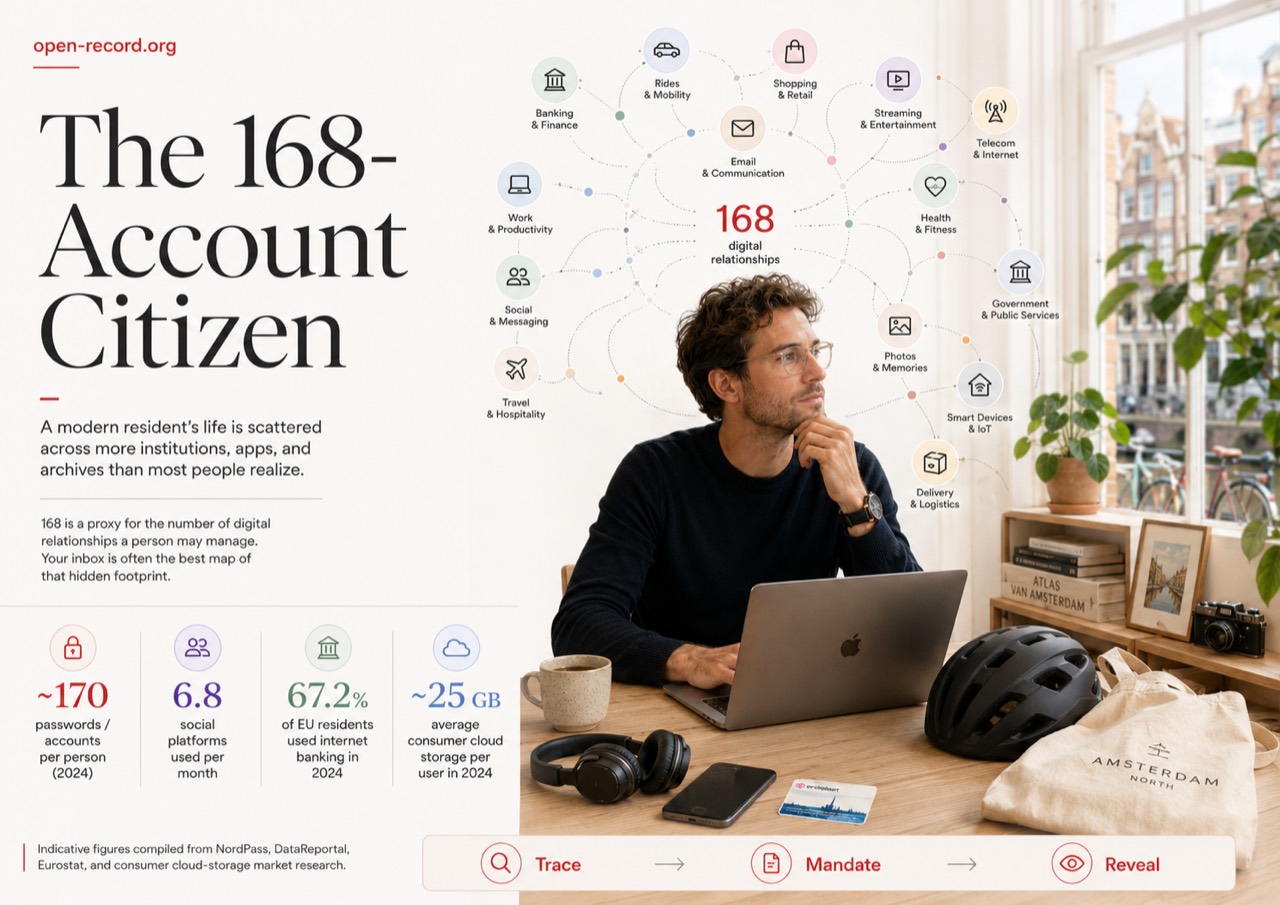
A visual essay about the ordinary digital relationships that leave fragments of a person's life across apps, institutions, services, and archives.
“168” is an illustrative lens for thinking about a scattered footprint—not a promise that every person has the same number of accounts.
Read the visual essayIf something feels unclear, the product should say so before asking you to act.
No. Employers are one kind of data holder. The broader goal is to help you understand and act across platforms, services, brokers, financial providers, public bodies, retailers, former accounts, and other organizations that may hold or infer information about you.
No. The private beta is built around review. You should be able to see the holder, route, request, scope, and any proof involved before an action is approved. Bulk or hidden sending is not the product model.
In the current private beta, an identity document is required before a supported request can proceed. It is not emailed to data holders by default. The intended proof ladder is route-specific and starts with less intrusive options where a holder can accept them.
Account, request, reply, and returned-file storage is configured for EU residency. The current private beta uses a controlled US-based subprocessor for identity-document field extraction if you upload an ID. The privacy notice explains each provider and data location.
That can be a valid security decision. The workflow should support delivery to your own account, a secure organization portal, or another route you approve. open-record.org coordinates the process; it does not claim every organization must deliver into its vault.
No. open-record.org helps make personal-data-rights workflows understandable and reviewable. It does not replace independent legal advice, and it cannot guarantee how an organization will respond.
Help shape a calmer, more trustworthy way to exercise personal-data rights across the internet.